Showing posts with label Travel. Show all posts

Thursday, August 22, 2013

One of the Prettiest Towns in America!


Regular readers of this blog will know how much we love our town, so it was no surprise to us to see Forbes.com select Lambertville as one of the fifteen prettiest towns in the America.


A panel that included travel experts from Frommer’s, Fodor’s, and even National Geographic said:


            “Tiny Lambertville on the shores of the Delaware River in western New Jersey, packs a lot of small-town punch, welcoming visitors with some of the best antique shopping in the Northeast, as well as with its selection of galleries, shops, and restaurants. “It’s quaint as heck, with a lot of old Atlantic flare.””


If a trip to Lambertville isn’t in your future you can always enjoy browsing our carefully curated selection of art and antiques HERE at Knickerbocker!

Photos by KS&D.

Sunday, March 25, 2012

Art History and Architecture on the Delaware Canal

The beautiful spring weather is perfect for exploring the canals and towpaths along the Delaware River. Last year we took a short stroll through a time-forgotten village in Upper Bucks County, this time we’re heading south to explore the history and architecture rich stretch between Centre Bridge and New Hope, Pennsylvania.


This pastoral complex of quintessential Bucks county fieldstone buildings makes up the historic Burgess Lea Farm. Built in the 18th century by Isaiah Paxson, a gentleman farmer, businessman, and partner in the company that built the bridge across the river in 1814 giving Centre Bridge its name. The farm is remarkably well preserved due to the fact that only two families owned it until 1978.


The large window on this stately stone Georgian once illuminated the studio of Edward Willis Redfield, the American Impressionist painter often credited with co-founding the New Hope Art Colony, as the group of artists who came to live and work along the river came to be known, when he moved to this house in 1898.


Redfield’s most famous work "The Burning of Center Bridge" was painted from memory to depict the dramatic night in 1923 when Isaiah Paxson’s original 112-year old wooden covered bridge was struck by lightening.


The rebuilt bridge as seen today connecting the village to the quaint town of Stockton, New Jersey, where the Stockton Inn immortalized in song by Broadway composers Rogers and Hart in the 1930’s was so popular with writers like F. Scott Fitzgerald their table was nicknamed the Algonquin Round Table after their famed New York City haunt.


Just north of the Redfield house an elegant formal garden guarded by lions lies along the canal.


Peaking out from the vegetation are the unmistakable salmon stucco walls and red tile roof of a 1920’s Mediterranean villa, a type more commonly associated with locales like Beverly Hills or Palm Beach than the banks of the Delaware River.


This is Playwicky, the Morris L. Cooke house designed in the 1920’s by renowned architect William Lawrence Bottomley. Cooke, who was appointed director of the Rural Electrification Administration by FDR, built the house for weekends in the country.


Topped by a picturesque combination chimney bell tower, the house also boasts the work of the master blacksmith Samuel Yellin.


One of the most charming features of this unique property has to be this delightful two-story octagonal garden tower retreat. Such fairy tale details make it easy to understand House and Garden’s description of Playwicki as the “playhouse of two traveled grownups”.


Next door to one unusual Jazz Age villa is oddly enough an even grander one. The Frederick L. Miller house was also designed in the 1920’s by Bottomley. A 1929 House and Garden article aptly titled “The House By The Canal” declared “Some of yesterday’s architecture and some from foreign lands are found in this country house…set against a background of woods, in a meadow through which flow the quiet waters of an old canal.”


Like something to be found along the shores of Lake Como, the house has been expanded and altered from its original design. Three sets of French doors for example now line the terrace where once a huge Palladian window added a curvilinear focal point to this long wing.


A 1926 photo of the nearly 40 foot long drawing room taken shortly after completion shows the original Palladian window looking out to the river. The large space was simply furnished with informal wicker and a comfortable upholstered wing chair and rolled arm sofa that speak to the casual country house vibe.


A 1927 image from The House Beautiful shows Bottomley’s original entrance before renovations. The simple arched doorway surmounted by a charmingly canopied wrought iron balcony was in keeping with the Italian farmhouse vernacular the architect originally intended. What look to be fruit trees planted close to the house again speak to the rustic farmhouse sensibility the estate once had.


The main façade is now far grander with a monumental entrance lording over a massive gravel forecourt transforming Bottomley’s Italian country farmhouse into an imposing mansion. While quiet a beautiful showplace one can’t help but wonder if a future owner might restore some of architects’ original scheme.


Flat-bottomed canal boats wait under the bridge behind the Centre Bridge Inn; an Inn has operated at this site for over two hundred years.


A cathedral-like alley of trees leading down to the river dramatically frames this elegant antique house of stucco over stone.


Tucked on the hillside just behind the white stucco house is this interesting structure with a huge multi-paned window that was no doubt once the studio of another local artist.


A classic Pennsylvania fieldstone farmhouse comfortably sited in a large clearing in the woods.


Yet another beautifully restored antique stone manor, this time situated on a tiny sliver of land between the canal and River Road. A tall trellis fence gives the place an air of mystery while lending privacy to the small but lavish garden.


At one end of the narrow garden sits this quaint slate roofed shed topped with a charming metal flower finial.


The American impressionist landscape painter William Langson Lathrop founded the New Hope Art Colony when he moved to this house at Phillips Mill in 1899. The early years of the twentieth century saw a cache of like-minded artists known as the Pennsylvania Impressionists flocking to join Lathrop and Redfield in capturing the local landscapes.


The Tow Path as painted by Lathrop who kept a boat to shuttle students along the canal from New Hope to his studio at Philips Mill.


Of course even with all the history and architecture to savor it’s impossible to stroll along the Delaware and not stop to appreciate the wonders of nature around you.

Photos 1-3, 5-11, 15-21, and 23 by KS&D.

Photo 12 via Library of Congress.

Photo 13 from The House Beautiful.

Photo 14 via Zillow more photos here.

Thursday, March 1, 2012

A Victorian City

A colonial ferry town on the road between New York and Philadelphia, Lambertville, New Jersey experienced a full fledged Industrial Revolution with the advent of the Delaware and Raritan Canal. Today this small city on the Delaware River still lays claim to a remarkably intact wealth of domestic Victorian architecture of all styles and classes.


At the grand end of the spectrum this Italianate stone manse wouldn’t look out of place in Newport’s older enclaves. The massive Tuscan style belvedere tower with it’s trios of arched windows along the top looks to be inspired by Osborne House, the summer home of Queen Victoria constructed a decade earlier.


Towers and turrets, the most romantic symbols of Victorian architecture, have many excellent examples across town. All Second Empire style homes feature some kind of mansard roof, but this unique tower can boast a concave roof atop a convex one. Once a private mansion, this stately stone edifice now serves as City Hall.


Overlooking a beautiful well-tended little park, the local woman's club features a concave mansard tower in a charming vernacular style with a quaint dollhouse feel.


The convex tower on this grand old painted lady has an imposing dome-like effect, in contrast to the inward slop of the mansard roof beneath it.


Just behind the yellow mansion, the original carriage house is adorned with a very interesting inward sloping gable. Combined with the brick façade and gothic arched windows it brings to mind a favorite building, John Fowler’s Hunting Lodge in Hampshire, England.


In contrast to all these slopes and curves, the straight lines of this tower have an almost contemporary feel. The dark green on light green color scheme is very effective at visually breaking up the masses of the structure.


Around the corner a similar tower has a very different feel on this elegant white house. Curved lines return on the bay window and porch roof, while a series of gracefully arched windows line the corner above. The curves continue up to the attic where a bull’s eye window sports a tiny half moon shade awning.


These pointed hexagonal turrets flank a large duplex house, an unusual style of which the town can also boast many interesting examples.


On this colorful block the two buildings to the right are both duplexes, the central house being designed and painted to appear as one while the house to the right is clearly designed and painted as two separate dwellings. The pretty peach house in the forefront features a wonderful Eastlake gingerbread porch.


Color of course plays a large part in the Victorian aesthetic, as evidenced by this boldly hued wooden townhouse, which also exhibits the popular trend for multiple surface textures.


This house with an interesting roof line also utilizes multiple surface textures include shingle, stucco, and stone from an earlier church that occupied the site. The tall gothic pointed window on the side is another relic of the church that was incorporated into the house.


The most interesting roofline of the bunch would have to be this unique structure, which also features a tiny balcony charmingly tucked above the corner bay window.


We hope you’ve enjoyed this brief tour that gives just a glimpse of the many architectural gems this quaint little city has to offer, many spanning well beyond Victorian.


Here for example an 1820's clapboard townhouse shows the transition into Victoriana with a frothy porch of lacy wrought iron. It really is too bad they don’t make porches like those anymore.

Photos by KS&D.

Monday, August 2, 2010

Venetian Splendor in New York

Venice with the sparkle of sun-dappled waters reflecting across her awe-inspiring architecture has always been one of our favorite destinations. Behind the lacey gothic windows of the Grand Canal lay many of the world’s most incredible interiors. However when a trip to Italy isn’t on the schedule a heavy dose of Venetian splendor can be had right in the heart of New York City.


Down a quiet hall of the Metropolitan Museum of Art lies a lavish bedroom removed in its entirety from the Sagredo Palace in Venice. This dramatic interior dating from 1718 is among the finest of its kind and instantly immerses you in the opulence of eighteenth century Venice. The elaborate stuccowork of the ceiling is awash with life-like winged figures soaring around the mural and down the cornice. The bed itself sits like a throne in a raised alcove crowned by an oval gilded dome. With soft light seeping through the frosted glass windows you could just imagine yourself waking as dawn breaks over the Venetian lagoon. If you decide you’d like to make that particular fantasy a reality it just so happens that back in Venice the Sagredo Palace, sans said bedroom of course, is now a luxury hotel.

Wednesday, July 21, 2010

The Work of Photographer Slim Aarons

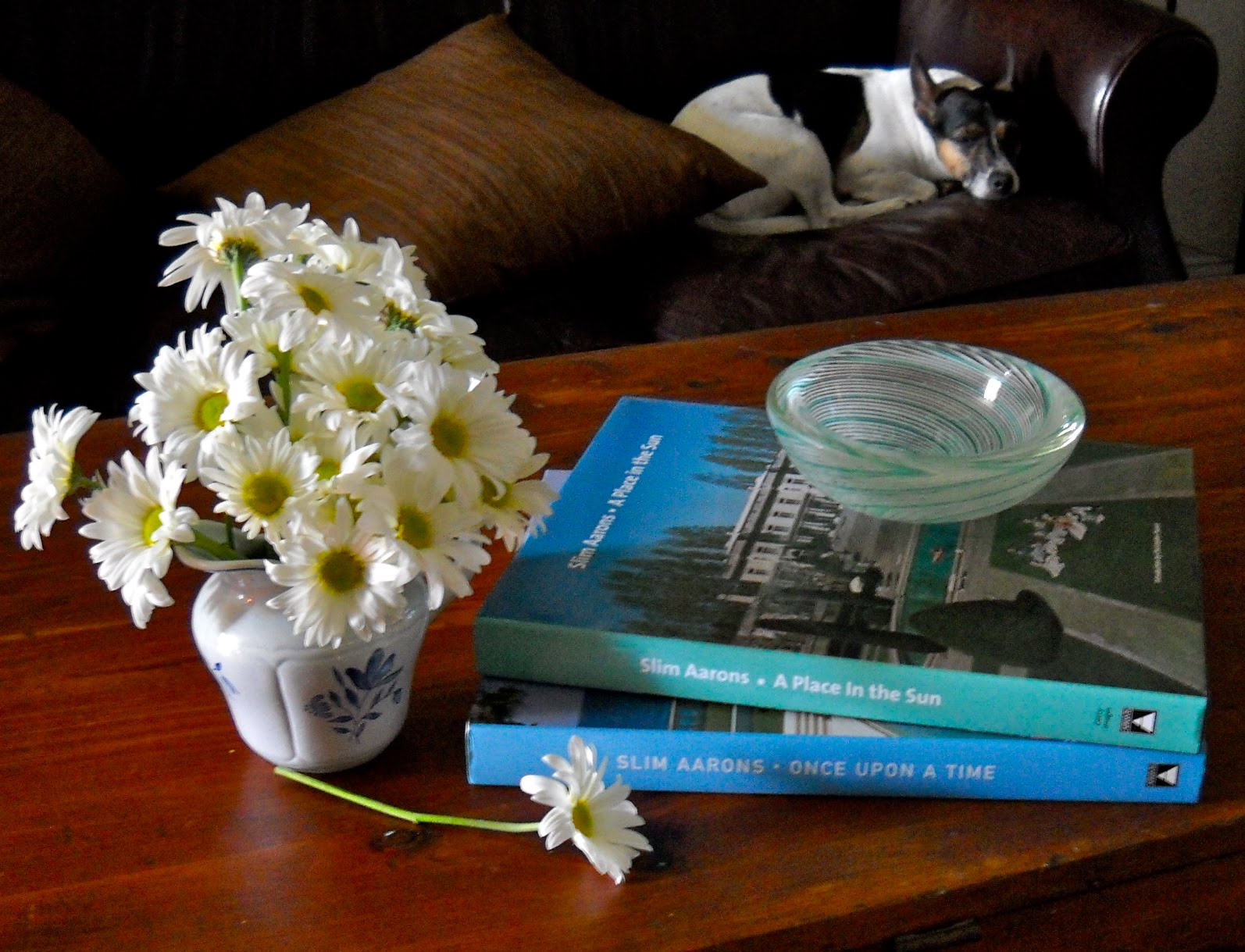
Everyone likes flipping through a pretty “coffee table book”, and with their lavish swimming pool cover shots two of our summertime favorites have to be Once Upon A Time and A Place in the Sun featuring the work of photographer Slim Aarons.


As portrait photographer for Town and Country, Holiday, and Life magazines, Slim once described his career as “photographing attractive people doing attractive things in attractive places”. From WWII until the 80’s he traveled the world photographing the rich and famous in their natural habitat. From high society and royalty to titans of industry and Hollywood celebrities the pages of these books are filled with the one glorious image after another.


Our books are seen here with a simple bouquet of daisies, the perfect summertime flower, arranged in an antique French Country china creamer. The swirling striations of the antique Venetian glass bowl beautifully match the soft sherbet hues on the books spines. Now all we're missing is the newest book, which appropriately enough is simply titled Poolside with Slim Aarons.

Photos and styling by Knickerbocker.

Thursday, May 27, 2010

At Home with the Romanovs

Our previous post on the Yusupov Mansion has me thinking back on my visit to Russia and all the sites I would love to see again as well as those I hadn’t the chance to see.
The most intriguing of these perhaps is one that may never be seen again as it was one of the lost private interiors of the last Tsar and Tsarina Nicholas and Alexandra. The Maple room of the Alexander Palace; so named for the lavish use of maple wood in it’s decoration; was conceived in 1902 as a private sitting room for the Tsarina and her children in the then very modern Art Nouveau style.
Among the most unique features of this space was an elaborately carved balcony spanning the room, which allowed Alexandra access to her husbands study across the hall while creating cozy nooks for her and the children around the tiled fireplace. In one of the opposite corners stood a massive custom designed semi-circular sofa surrounded by a ledge for displaying objects d’art and surmounted by an elegantly carved Maplewood cabinet which once held the Tsarina’s famous collection of Faberge eggs. Surrounding this comfortable nook are framed family portraits reminding us this was indeed a family room, albeit for one of the wealthiest and most powerful families on earth.
One of the most spectacular aspects of this eclectic gem had to be the incredible ceiling treatment of realistically detailed plaster roses concealing a then cutting edge indirect lighting system that would bath the ceiling in a soft green light. Perhaps one day this unique work of interior design will be restored to enchant visitors once again with its one-of-a-kind style. Anyone interested in more information on the Maple Room, the Alexander Palace, or the Romanov family should be sure to visit the incredible website Alexander Palace Time Machine.

Thursday, May 20, 2010

Antique Window Glass


With our love for all things old, unique, and beautiful it will come as no surprise that we at Knickerbocker are completely enamored by old window glass. These ancient handmade panes are awash with swirling imperfections capable of softening any view into a mesmerizing impressionist painting. The view pictured here of course isn’t just any view. In fact we shot this image at the Capitoline Museums in Rome where the entire complex; including that dreamy balcony just beyond the doors; was designed over 400 years ago by none other than Michelangelo himself.

Monday, May 17, 2010

Russian Rococo Restored

After revisiting Rio’s Lage Mansion in a previous post I wanted to share another inspiring residence encountered on my travels.

I first came upon the Yusupov Pavilion several years ago on a tour of St. Petersburg and it’s environs. The long neglected structure was undergoing a complete restoration and my group was invited to witness craftsmen fashioning plaster into the froth of Rococo scrolls encrusting the exterior.

Built in 1856 by architect I. Moniguetti, this exuberant Rococo fantasy was inspired by the great palaces designed a century earlier by the Italian master Bartolomeo Rastrelli, including the nearby Catherine Palace at Tsarskoe Selo. For wonderful artistic images of the ruined building before restoration see numbers 13 and 14 in the gallery here.

The beautiful summerhouse seen here in a period photo was built for Princess Zinaida Yusupova to house her collections of fine art and rare minerals. It's said the Princess was originally offered the mansion by the Tsar himself in exchange for her participation in amorous endeavors. Being one of the wealthiest women in Russia she chose instead to decline his advances and simply have the plans constructed herself. The Yusopov family is perhaps best known to history for Zinaida’s great grandson Prince Felix’s involvement in the assassination of Rasputin at one of the Yusupov’s St. Petersburg palaces.
Related Posts with Thumbnails