Showing posts with label Art. Show all posts

Tuesday, September 10, 2013

Filling in the Gaps


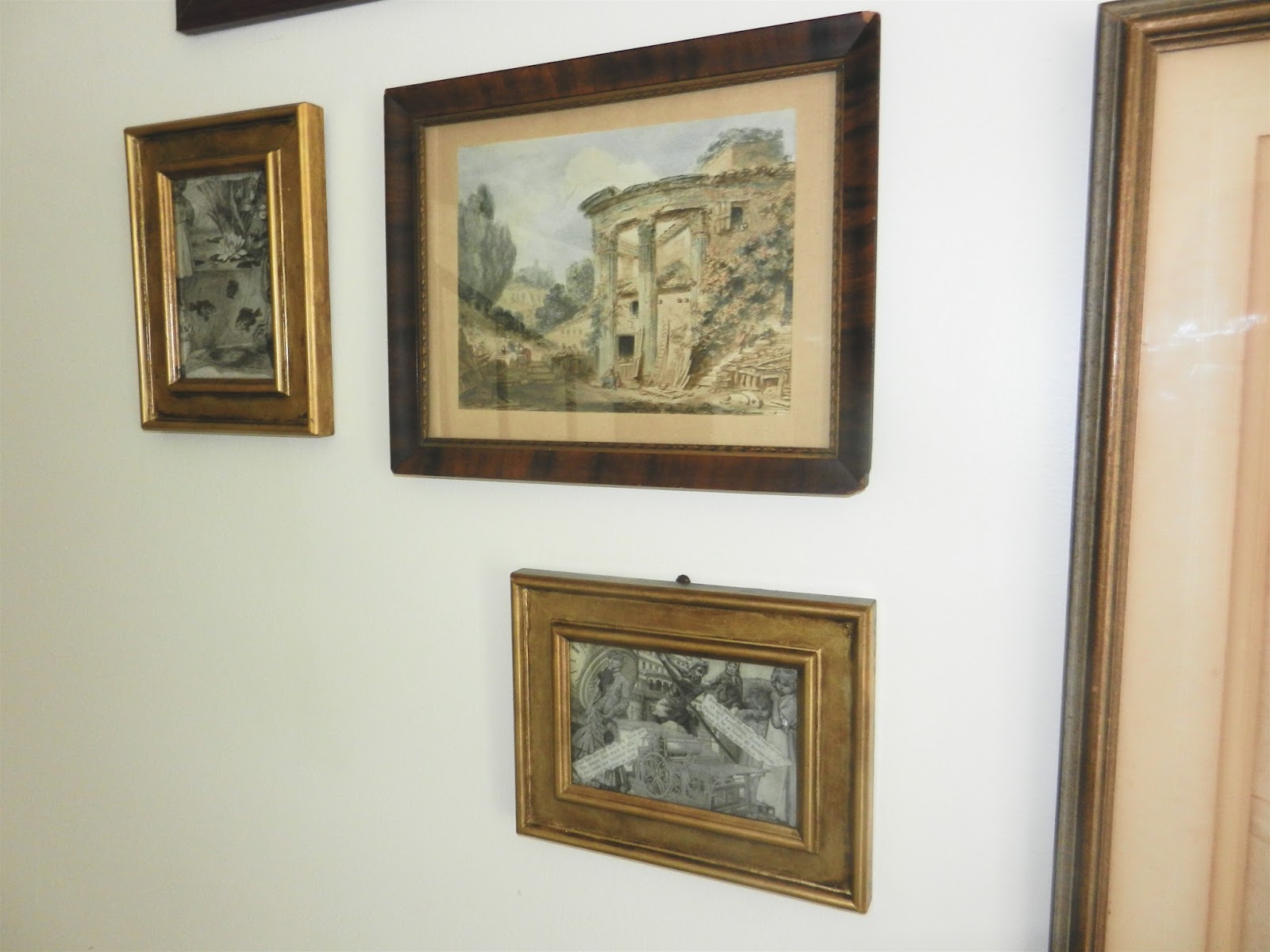
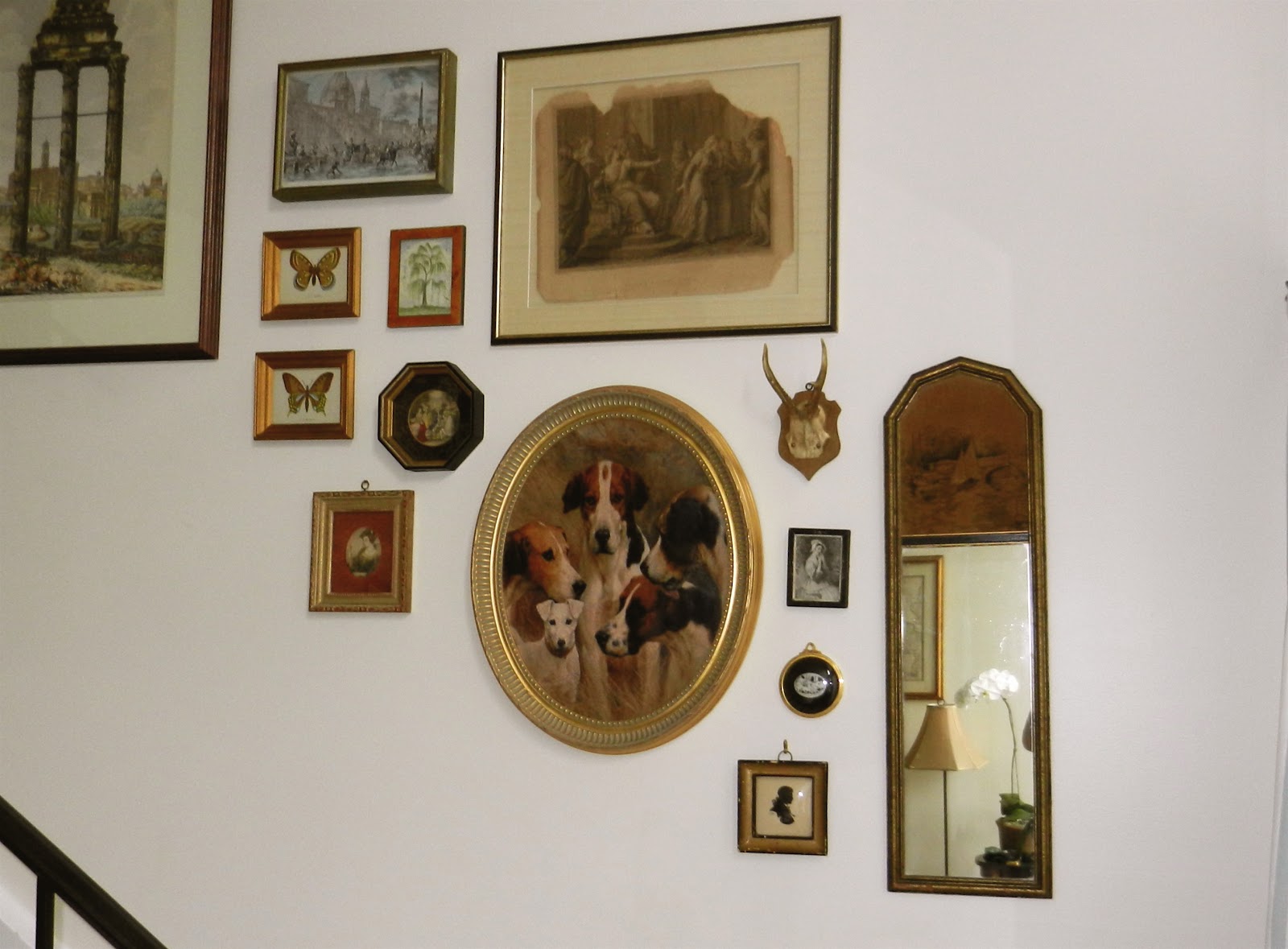
It’s been sometime since we first posted about our ever-growing staircase gallery wall and as you can see it’s really starting to fill out.


Brooke Astor’s dog portrait still holds pride of place at the base of the stairs but plenty of other pieces have come and gone in this ever-changing display.


Many smaller pieces have been added above and below the larger ones to help fill in the gaps and emphasize the stepped diagonal lines of the total composition.


Among the little jewels that help to strengthen the visual diagonal are a small collection of handcrafted collages inspired by the decoupage panels we created to adorn our antique cabinet last year.


The collages include intricately hand cut illustrations and advertising imagery mixed with poetry and even sheet music, all taken directly from antique Harper’s Magazines dating from the 1860’s to 1880’s and decoupaged directly to the backside of the glass.


These completely one-of-a-kind works of art, reminiscent of the scrap folk art so popular in the Victorian era from which the magazines date, are currently available here in our eclectic online shop Knickerbocker Antiques and Vintage along with many other items seen along our gallery wall.

Photos by KS&D.

Wednesday, July 24, 2013

An Abstract Art Series


 As we’ve said before nothing brings more interest to an eclectic interior than pairing modern abstract art with traditional antique and vintage pieces.


 Contemporary artist Nicholas Adamko has recently completed this exciting series of six beautiful abstract oil paintings to be offered individually online through Knickerbocker Antiques and Vintage.


 At once calming and chaotic the energy and movement of the art creates endless levels of depth and dimension to entertain the viewer.


 A generous use of paint creates depth and texture when applied in the artists trademark free-form grid pattern of bold north-south and east-west brushstrokes that brings order amidst chaos.


 The artist originally developed this signature style over a decade ago while still an art student at the Fashion Institute of Technology in New York City, and has continued to explore the myriad effects it can achieve.


 Paintings in the series span the saturation spectrum from a rainbow kaleidoscope of deep bold hues to more muted shades of grey and white.


 The heavy use of off-white paint mixing through and over the other colors creates an overall neutral effect that allows these works to complement and enliven any interior.


 The paintings also offer a variety of textures with some flowing more smoothly from hue to hue while others are especially rough and course, an effect controlled by the drying time allowed between layers.


 The time consuming process may take three or even four layers with each subsequent layer nearly covering the one beneath until the desired texture is achieved.


 Each work is rendered in oil on a canvas measuring 16” by 20”, the perfect size to display alone or in groups for added drama as seen here.


 Be sure to visit Knickerbocker’s online art gallery to see larger sofa-sized works by the artist as well as some of his more impressionist style landscapes.

Photos by KS&D.

Thursday, February 28, 2013

Abstract Modern Art in a Traditional Eclectic Room

Mixing and matching periods, styles, materials, and textures is essential to the eclectic aesthetic and adds much interest and life to a space.


This mainly traditional living room furnished with a bohemian mix of antique and vintage pieces is centered around a large contemporary abstract oil painting with calming almost impressionist style colors and brushwork that blends beautifully with the eclectic mix of art, accessories, and textiles.


The constellation of rustic metal barn stars mounted on the wall above once decorated the exterior of our carriage house in rural Bucks County. The play of primitive folk art against modern art makes for an interesting juxtaposition, while the colors of the rusted metal and patinated copper pick up the same hues in the painting.


The pair of large oxblood red Chinese ginger jars also compliment the hues in the painting and match the color of the rusted stars above while providing an elegant foil to their rustic texture and perfect companions for the small classical sculpture that adds a final grace note to the vignette.


The neutral fabrics in the room let the art and accessories take center stage but still keep the eclectic theme by contrasting a simple white Belgian linen slipcover with a luxurious cut silk velvet throw blanket and a vintage tapestry pillow.

Click HERE to shop the newest arrivals in eclectic antique and vintage accessories and fine art in our online boutique Knickerbocker Antiques and Vintage!

Styling and photos by KS&D.

Thursday, October 18, 2012

Brooke Astor's Collections at Auction


When we first moved to the loft and found ourselves really considering what went into designing a great gallery wall along a staircase, there was one example we returned to time and again…


Brooke Astor’s famous collection of dog paintings seen above and below marching up the elegant floating staircase of her country estate Holly Hilly overlooking the Hudson River, before being auctioned September 24th and 25th at Sotheby’s along with the rest of Mrs. Astor’s estate in a media frenzied sale that more than doubled high estimates and totaled nearly $19 million.


Of course even though it was stretched over two days, Sotheby’s couldn’t possibly divest the entire contents of both Holly Hilly as well her Park Avenue duplex decorated by Sister Parrish and Albert Hadley. The remaining mementos of Mrs. Astor’s privileged life turned up at auction October 5th at Stair Galleries of Hudson, New York in an anonymous sale simply titled “Property of a Lady”. A close inspection of the contents clearly identified the anonymous ‘Lady’ as none other than Brooke Astor, and while the sale received little media attention was written up by must-read style blogger and Architectural Digest contributor Mitchell Owens on the magazine’s blog.


Anyone with the time and inclination could easily peruse the catalogue and recognize several pieces from photographed interiors of the country estate and Park Avenue duplex. For example a quick Google images search for Brooke Astor’s Holly Hilly will most likely turn up the image of the curving staircase at the beginning of this post as taken by Sotheby’s. Those with a keen eye might notice the oval portrait in the lower left corner just behind the wrought iron railing as similar to one we’ve added to our own staircase gallery wall above. Those with an especially keen eye might even recognize the wooden farm basket Mrs. Astor used to hold books under her stairs as identical to the one seen above under our own far humbler flight.


It is in fact Mrs. Astor’s dog group portrait, or 20th Century School: “The Hunt Dogs” formerly Lot 251 of Stair Galleries Property of a Lady sale. While the bulk of Astor’s antique dog paintings went for nearly a million dollars in the Sotheby’s auction this piece being a newer reproduction was sent to the anonymous sale where we were delighted to acquire it at an exceptional price especially given the exceptional provenance. Legendary philanthropist and socialite Roberta Brooke Russell Kuser Marshall Astor who died in 2007 at the age of 105 was the widow of Vincent Astor, the last heir to the great Astor fortune who’s father John Jacob Astor IV went down in history as the richest man to die in the sinking of the Titanic and who’s grandmother Caroline literally defined American High Society in the Gilded Age.


While Brooke Astor was regarded as the defacto Queen of New York during her lifetime she was more than a last living bridge to the Gilded Age, spending half her life giving nearly $200 million of the Astor fortune back to the city that had created it. Aside from her philanthropic works and glittering social life Mrs. Astor had an eye for beauty and design working at House and Garden and as well as a stint with Dorothy Draper before becoming Mrs. Astor, and in 1982 writing a lovely piece on collecting for Architectural Digest discussing her dog portraits as well as the illusive subject of taste. At the end the author ponders her collection hitting the auction block hoping one day they’ll be loved as much as she’s loved them. Brooke Astor clearly loved this charming pack of pups enough to not only mix with her antique originals but to give such prominent placement, and we'd gladly assure her they’ve found a very loving home along with some of her other animal collections, but we’ll have to save those treasures for a future post.

Click HERE to read the next post on the Astor auction!

*While “The Hunt Dogs” are not for sale many of the surrounding art and accessories are available for purchase HERE in our online boutique Knickerbocker Antiques and Vintage.

Photos 1 & 2 via Sotheby's and photos 3 - 5 by KS&D.

Thursday, September 27, 2012

New Impressionist and Abstract Oil Paintings

More new oil paintings now available exclusively in our online gallery of original fine art!


Another beautiful country landscape rendered in the artist's classic impressionist style.


The verdant greens and expressive brushwork impart a sense of calm and restfulness to this shady meadow at the edge of a wood.


For the collector in search of a bolder more contemporary work of art we're excited to offer this large and dramatic oil painting in the style of abstract expressionism.


The seemingly wild kaleidoscope of colors is tamed upon closer inspection by a cross hatch technique in the brushwork that bring much depth and texture to this lively piece.


For more fine and decorative arts be sure to visit our online boutique!


Wednesday, August 22, 2012

Impressionist Landscape Oil Paintings


Knickerbocker is pleased to add these new American landscapes to our online gallery of original fine art.


This contemporary landscape painting vividly depicts a quiet county canal near the artist’s home in a modern impressionist style.


Lush coloring and bold brushwork capture the play of sunlight on the leaves of the trees as well as the rippling shadows and reflections on the water.


Another contemporary landscape painting depicts an early spring sunset over the fields and forests of a farm in Bucks County, Pennsylvania.


The artist has again utilized bold brushwork, this time with a deeper color palate to render a traditional sunset landscape in a fresh and modern way.

Click HERE for more original fine art.

Friday, July 27, 2012

A New Look For The Old Cabinet


Regular visitors to our blog might remember this three arch cabinet from last year when we curtained the windows to mask inventory for our online antique shop.


While the curtains were a good quick fix they weren’t exactly the most interesting things to look at.


Inspired by the tradition of decoupage furniture we decided to create a series of collage panels to display behind the arched glass doors that could be easily removed when desired.


After considering a variety of themes and materials like sheet music or playing cards we found the remains of a damaged 1870’s art book that still contained hundreds of random pages filled with illustrations.


The subjects include many famous works throughout art history and examples of decorative arts, as well as highlights in contemporary fine art of the 1870’s.


Even the fancifully decorated letters were carefully clipped and arranged like scrabble tiles to spell out words and phrases.


Here gothic letters arranged to spelling out “The Mad Poet” are used to frame an engraving titled ‘Milton Dictating Paradise Lost to His Daughters’.


The Victorian period art book was perfect for this project, as not only was decoupage a popular Victorian folk art, but the cabinet sits in a loft in a Victorian era opera house that was in it’s heyday when the book was originally published.


Since the illustrations are all black and white engravings, the finished collages have a neutral pattern-like appearance that makes a richly detailed backdrop for this colorful orchid and a selection of antique and vintage accessories.

Click HERE to see what’s hidden inside the cabinet as well as the newest arrivals in our online design boutique Knickerbocker Antiques and Vintage!

Photos and styling by KS&D.

Thursday, April 5, 2012

Designing A Staircase Gallery Wall

Creating a well-balanced gallery wall can be challenging but putting the display on the diagonal is an entirely different story.


This staircase is lined with a dramatic display of classical prints mixed with Mid-Century Modern art that forms an eclectic backdrop for a small sitting area.


The orderly composition is centered on a large print depicting ruins of the Roman Forum flanked by antique Italian reverse hand painted art glass wall panels of delicate classical design.


The traditional brown leather rolled arm sofa is dressed up with a trio of throw pillows in orange, teal, and yellow Chinese silk, a fun spring/ summer color scheme that adds a dose of 60’s chic. In another nod to Mid-Century style a collection of vintage Murano art glass bowls pop on the cocktail table like blossoms of color, while antique and vintage brass accessories lend a metallic note to the end tables.

Vignette photos and staging by KS&D.

Art and accessories available HERE.

Sunday, March 25, 2012

Art History and Architecture on the Delaware Canal

The beautiful spring weather is perfect for exploring the canals and towpaths along the Delaware River. Last year we took a short stroll through a time-forgotten village in Upper Bucks County, this time we’re heading south to explore the history and architecture rich stretch between Centre Bridge and New Hope, Pennsylvania.


This pastoral complex of quintessential Bucks county fieldstone buildings makes up the historic Burgess Lea Farm. Built in the 18th century by Isaiah Paxson, a gentleman farmer, businessman, and partner in the company that built the bridge across the river in 1814 giving Centre Bridge its name. The farm is remarkably well preserved due to the fact that only two families owned it until 1978.


The large window on this stately stone Georgian once illuminated the studio of Edward Willis Redfield, the American Impressionist painter often credited with co-founding the New Hope Art Colony, as the group of artists who came to live and work along the river came to be known, when he moved to this house in 1898.


Redfield’s most famous work "The Burning of Center Bridge" was painted from memory to depict the dramatic night in 1923 when Isaiah Paxson’s original 112-year old wooden covered bridge was struck by lightening.


The rebuilt bridge as seen today connecting the village to the quaint town of Stockton, New Jersey, where the Stockton Inn immortalized in song by Broadway composers Rogers and Hart in the 1930’s was so popular with writers like F. Scott Fitzgerald their table was nicknamed the Algonquin Round Table after their famed New York City haunt.


Just north of the Redfield house an elegant formal garden guarded by lions lies along the canal.


Peaking out from the vegetation are the unmistakable salmon stucco walls and red tile roof of a 1920’s Mediterranean villa, a type more commonly associated with locales like Beverly Hills or Palm Beach than the banks of the Delaware River.


This is Playwicky, the Morris L. Cooke house designed in the 1920’s by renowned architect William Lawrence Bottomley. Cooke, who was appointed director of the Rural Electrification Administration by FDR, built the house for weekends in the country.


Topped by a picturesque combination chimney bell tower, the house also boasts the work of the master blacksmith Samuel Yellin.


One of the most charming features of this unique property has to be this delightful two-story octagonal garden tower retreat. Such fairy tale details make it easy to understand House and Garden’s description of Playwicki as the “playhouse of two traveled grownups”.


Next door to one unusual Jazz Age villa is oddly enough an even grander one. The Frederick L. Miller house was also designed in the 1920’s by Bottomley. A 1929 House and Garden article aptly titled “The House By The Canal” declared “Some of yesterday’s architecture and some from foreign lands are found in this country house…set against a background of woods, in a meadow through which flow the quiet waters of an old canal.”


Like something to be found along the shores of Lake Como, the house has been expanded and altered from its original design. Three sets of French doors for example now line the terrace where once a huge Palladian window added a curvilinear focal point to this long wing.


A 1926 photo of the nearly 40 foot long drawing room taken shortly after completion shows the original Palladian window looking out to the river. The large space was simply furnished with informal wicker and a comfortable upholstered wing chair and rolled arm sofa that speak to the casual country house vibe.


A 1927 image from The House Beautiful shows Bottomley’s original entrance before renovations. The simple arched doorway surmounted by a charmingly canopied wrought iron balcony was in keeping with the Italian farmhouse vernacular the architect originally intended. What look to be fruit trees planted close to the house again speak to the rustic farmhouse sensibility the estate once had.


The main façade is now far grander with a monumental entrance lording over a massive gravel forecourt transforming Bottomley’s Italian country farmhouse into an imposing mansion. While quiet a beautiful showplace one can’t help but wonder if a future owner might restore some of architects’ original scheme.


Flat-bottomed canal boats wait under the bridge behind the Centre Bridge Inn; an Inn has operated at this site for over two hundred years.


A cathedral-like alley of trees leading down to the river dramatically frames this elegant antique house of stucco over stone.


Tucked on the hillside just behind the white stucco house is this interesting structure with a huge multi-paned window that was no doubt once the studio of another local artist.


A classic Pennsylvania fieldstone farmhouse comfortably sited in a large clearing in the woods.


Yet another beautifully restored antique stone manor, this time situated on a tiny sliver of land between the canal and River Road. A tall trellis fence gives the place an air of mystery while lending privacy to the small but lavish garden.


At one end of the narrow garden sits this quaint slate roofed shed topped with a charming metal flower finial.


The American impressionist landscape painter William Langson Lathrop founded the New Hope Art Colony when he moved to this house at Phillips Mill in 1899. The early years of the twentieth century saw a cache of like-minded artists known as the Pennsylvania Impressionists flocking to join Lathrop and Redfield in capturing the local landscapes.


The Tow Path as painted by Lathrop who kept a boat to shuttle students along the canal from New Hope to his studio at Philips Mill.


Of course even with all the history and architecture to savor it’s impossible to stroll along the Delaware and not stop to appreciate the wonders of nature around you.

Photos 1-3, 5-11, 15-21, and 23 by KS&D.

Photo 12 via Library of Congress.

Photo 13 from The House Beautiful.

Photo 14 via Zillow more photos here.

Related Posts with Thumbnails